

 English
 Español
 عربى
عربى русский
You are driving on a two-lane rural highway when a dense wall of fog rolls in. Your first instinct is to switch to the brightest setting you have. That instinct is wrong. When driving in fog you should use your low beam headlights, not your high beams, and you should turn on your fog lights if your vehicle has them. The reason is simple: high beams reflect off the water droplets suspended in the air and fill your vision with glare. This article explains the science behind that rule, the practical steps for safe fog driving, and how to choose the right fog light upgrade.
The Answer to "When Driving in Fog You Should Use"
Across nearly every US state driving manual, the wording is consistent. The answer to "when driving in fog you should use" is: low beam headlights. Some manuals add a note that you should also turn on fog lights if your vehicle is equipped with them. High beams or driving beams should never be used in fog.
The table below shows the typical behavior of each beam setting:
| Beam Setting | Beam Aim | Behavior in Fog | Recommended |
|---|---|---|---|
| High Beams | Long distance, upward | Reflects off water droplets, creates a bright glare wall | Never use |
| Low Beams | Shorter, aimed down | Lights the road surface closer to the car, less scatter | Always use |
| Fog Lights | Wide and flat, low mounting | Illuminates lane edges and road markings under the fog layer | Use with low beams |
The difference is not a matter of brightness. High beams are brighter, yet they make visibility worse. This is a common trick question on DMV written exams because it tests real understanding, not just memorization. Low beams are more useful because they are angled downward, so the light hits the road surface and reflects back to your eyes from below rather than bouncing off the fog droplets above your field of view.
Why High Beams Make Fog Worse: The Physics of Light Scatter
When your headlights pass through fog, the light interacts with suspended water droplets. Fog is technically a cloud that touches the ground, and its droplets are often between 1 and 100 micrometers in diameter. When a light ray strikes these droplets, it scatters in many directions. Physicists call this phenomenon Mie scattering.
For a driver, this has one clear consequence: the higher the beam is aimed, the more droplets it illuminates, and the more light reflects back into your eyes. High beams are designed to see far down a dark road. In clear weather, that long reach is useful. In fog, it bounces off thousands of particles, and the bright wall of reflected light reduces your ability to see the road ahead. National weather service safety guidelines repeat this warning: never use high beams in fog, because they create glare and make it harder for you to see.
Low beams are designed with a sharp cutoff that limits upward light. That keeps the beam close to the ground, where the road surface and lane markings are visible. In dense fog, low beams give you a much better chance of seeing the road edge than high beams ever will. If visibility drops below roughly 50 meters, even low beams may not be enough. At that point, the correct response is to slow down dramatically or pull off the road entirely.
Understanding this effect is also helpful if you are thinking about upgrading any part of your lighting system. A proper beam cutoff and a low mounting point are far more valuable than brightness alone in foggy conditions.
Fog Lights: When You Can Use More Than Just Low Beams
Fog lights are not a substitute for low beams; they are a complement. In most cars, fog lights are mounted low in the bumper, typically 10 to 20 inches above the ground. They produce a wide, flat beam pattern that lights the area directly in front of the vehicle without kicking light back into the driver's eyes.
The design logic is straightforward: place the light source as low as possible and cut the top of the beam sharply. Since fog sits close to the ground, a properly placed fog light can pass under the fog layer and illuminate the road surface, road edge, and lane stripes.
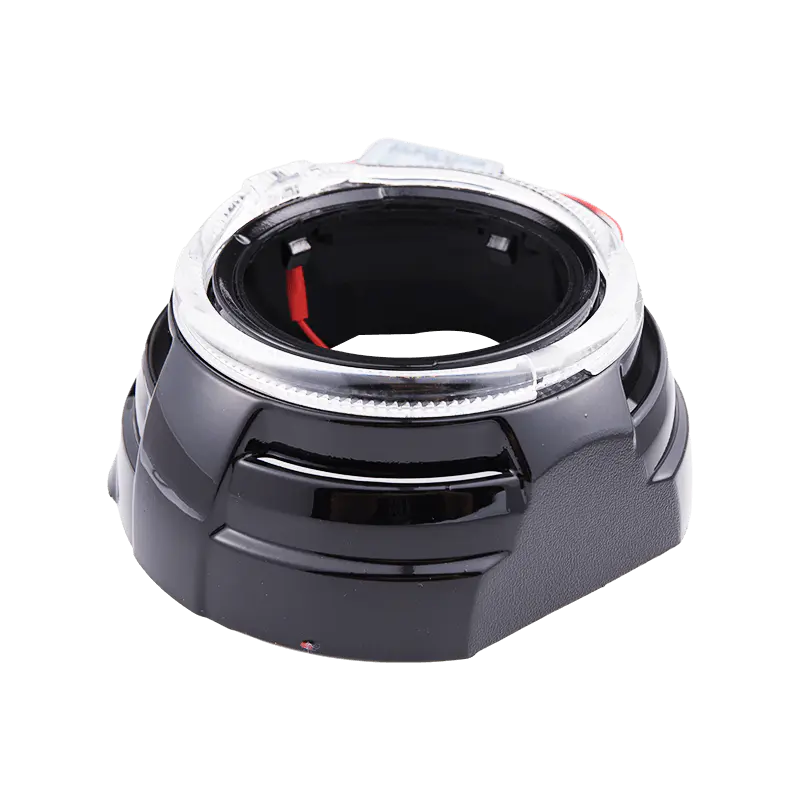
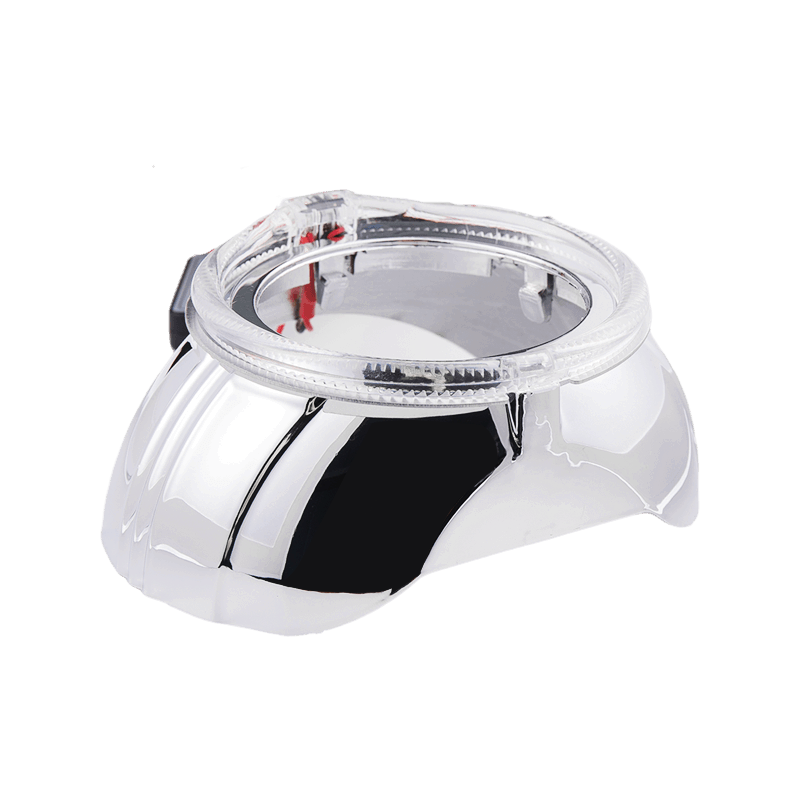
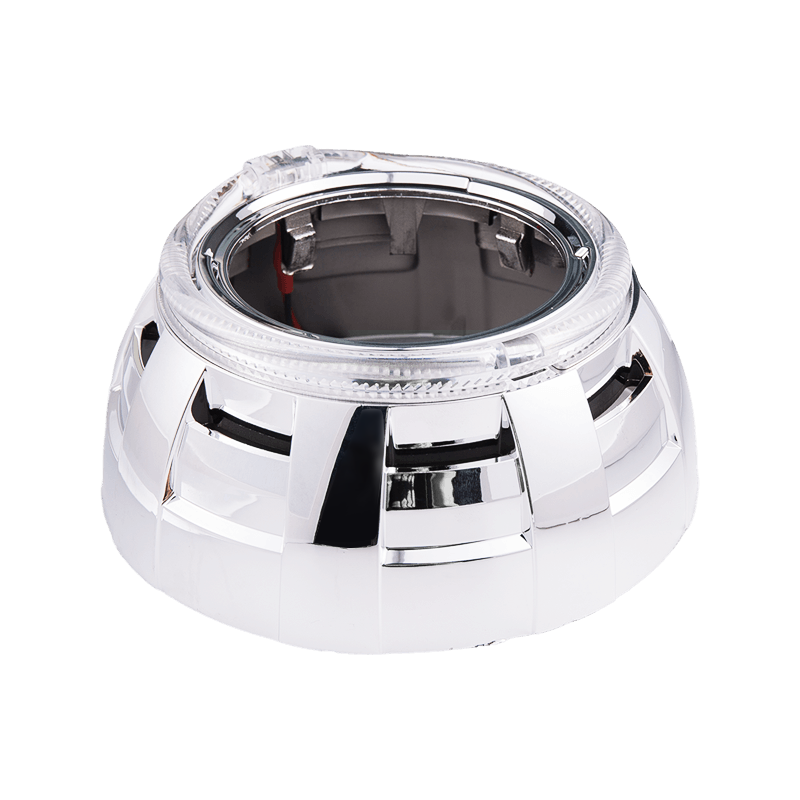
Many modern vehicles use LED projector optics for their fog lamps. A 3-inch H11 integrated LED fog light lens replaces the standard reflector with a projector lens that provides a controlled horizontal cutoff. This kind of upgrade is popular because it improves low-lying illumination without creating glare. On older cars, the factory halogen fog light often dims with age. Replacing it with an integrated LED fog light lens can restore the broad, low pattern that the original lamp was supposed to deliver in poor weather.
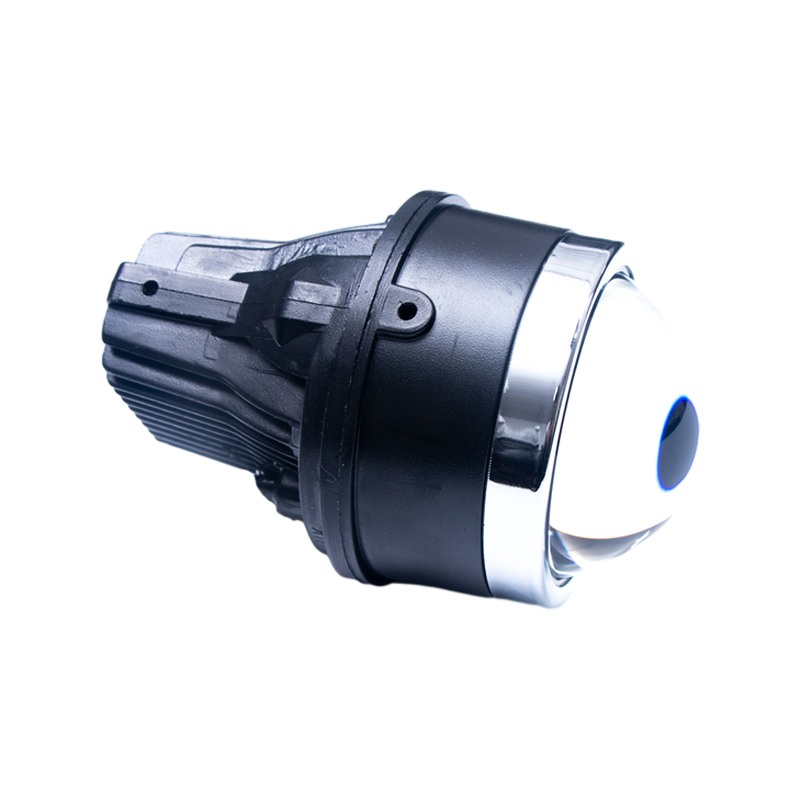 3-Inch H11 Integrated LED Fog Light Lens with 6000K Cool WhiteThis 3-inch H11 LED fog light lens uses a projector optic to replace older reflectors, offering a controlled horizontal cutoff. It is designed for low-lying illumination in fog, rain, or dust, helping restore the original beam pattern on older vehicles.View Product →
If you drive regularly in fog, rain, or dust, the state of your fog lights is a real safety consideration. A well-designed projector lens keeps a predictable beam shape, which matters more than raw brightness when you are trying to see through mist.
Safe Driving Protocol in Fog: What Else to Do
Lighting is only one part of safe fog driving. Even with the correct beam setting, you still need to adjust your speed, following distance, and overall behavior. Here is a practical checklist:
- Slow down to match your visibility. If you can see about 100 meters ahead, keep your speed at 40 km/h or less.
- Use low beams and, if available, fog lights. Never use high beams.
- Increase the gap between your car and the vehicle ahead to at least five seconds.
- Do not rely on the tail lights of the car in front. Many drivers follow too closely because they are tempted to focus on those lights, but this hides your own stopping distance.
- Use painted lane markings and the edge line to keep your position on the road.
- If visibility drops below about 20 meters, find a safe place to pull off the road. Turn on your hazard lights and wait for conditions to improve.
Remember: when driving in fog, you should use your low beams, not your high beams, and slow down to a speed that allows you to stop within the distance you can see ahead.
The standard meteorological definition of dense fog is visibility below 400 meters, while severe fog is below 50 meters. Below 50 meters, your reaction time becomes the critical factor. At 30 km/h, you cover roughly 8.3 meters per second. If you can only see 30 meters, that gives you less than four seconds to react. No lighting system can fix that problem: only a slower speed can. Some newer cars attempt to address this with intelligent brightness control, and you can read about how vehicle speed and integrated LED fog lights adjust brightness for more detail on that feature.
Choosing the Right Fog Light Lens for Your Vehicle
If you plan to upgrade your fog lights, the key values to compare are beam pattern, output, color temperature, and build quality. A projector lens with a horizontal cutoff will prevent light from skipping up into the fog, while a compact 2.5-inch unit fits tighter bumper cutouts on many cars.
Here is what to look for:
| Specification | Why It Matters |
|---|---|
| Lumen Output (lm) | Higher lumens help in dark conditions, but only when the beam is aimed low. |
| Color Temperature | 6000K is a common white; 3000K yellow is preferred by some drivers for less scatter in mist. |
| Waterproof Rating | IP67 or IP68 protection prevents moisture ingress from rain and road spray. |
| Housing Material | Aluminum (such as 6063 aviation-grade) improves heat dissipation and longevity. |
| Installation Type | Integrated units with a built-in driver are simpler to install than separate retrofit kits. |
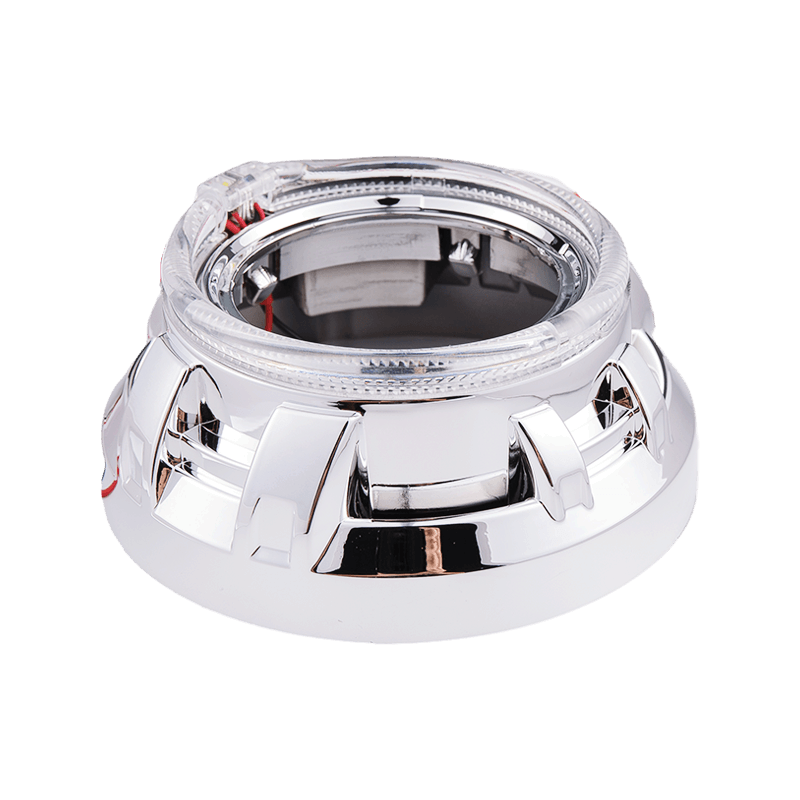
For compact cars and smaller SUV bumpers, a 2.5-inch integrated LED fog light bifocal lens is a practical fit. It provides a focused spot with a sharp cutoff while keeping the overall size small enough to fit standard fog light openings.
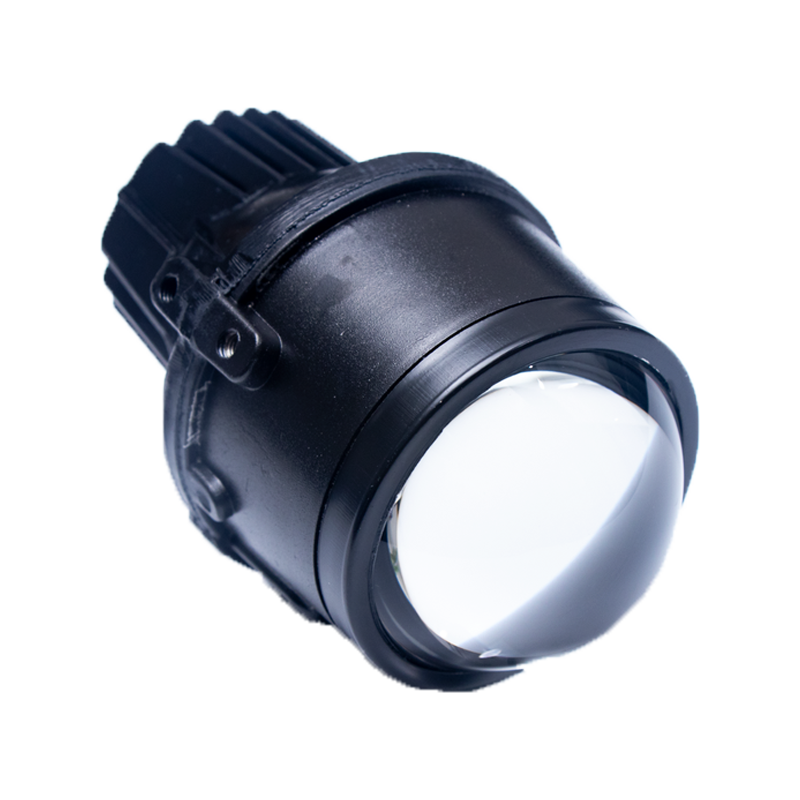 2.5-Inch Integrated LED Fog Light Bifocal Lens Compact FitThis 2.5-inch integrated LED fog light bifocal lens offers a focused spot with a sharp cutoff in a compact size, making it suitable for standard fog light openings on smaller cars and SUVs.View Product →
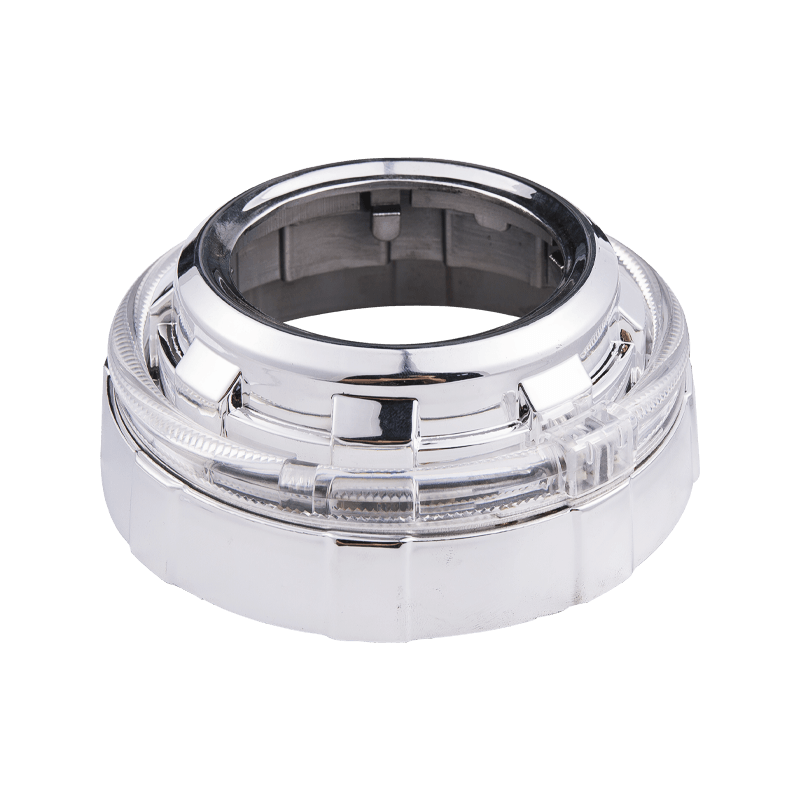
Drivers who want more punch for highway use in low visibility can look at a high-output option. The 10,000 lumen 45W integrated LED fog light bifocal lens is designed for stronger brightness while still maintaining a low, wide beam pattern. That combination is what makes it useful for fog rather than just decorative lighting.
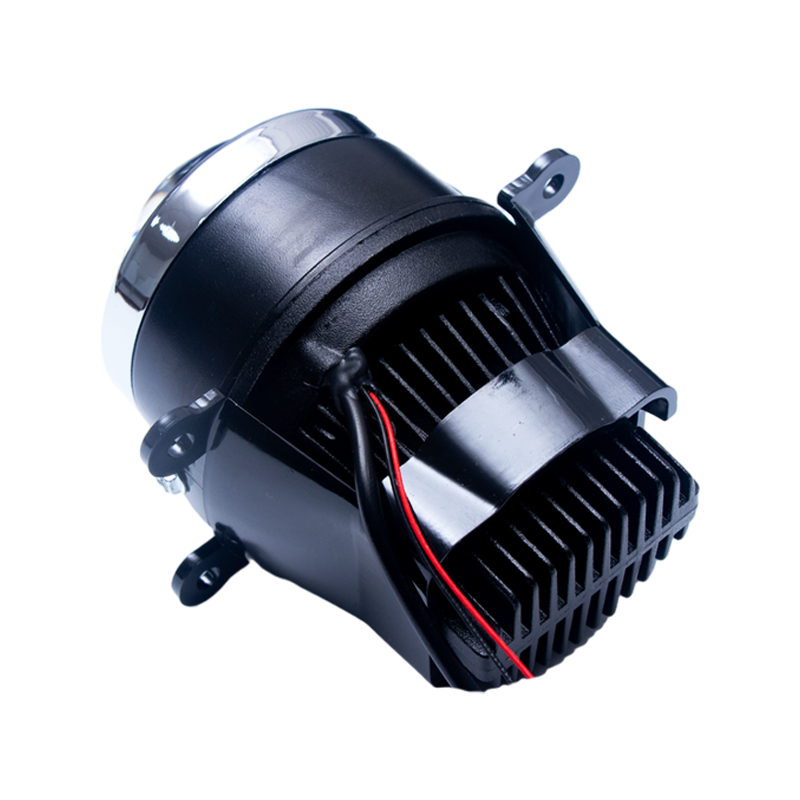 10000LM 45W Integrated LED Fog Light Bifocal LensWith 10,000 lumens and 45W output, this integrated LED fog light bifocal lens delivers high brightness while maintaining a low, wide beam pattern, useful for highway driving in low visibility.View Product →
You can read more about how LED projector lenses and yellow fog lights outperform standard fog lamps to understand why projector optics are generally better than simple reflector-style fog lights when the weather turns bad.
FAQ: When Driving in Fog, What Should You Use?
Q1: When driving in fog, you should use which type of headlight?
Use low beam headlights. If your vehicle has fog lights, you should turn them on as well. Do not use high beams, because they will reflect off the fog and reduce your visibility even further.
Q2: Can fog lights be used together with low beams?
Yes. Most vehicles allow both systems to operate simultaneously. When used together, they provide a combined beam that lights the road closer and more evenly while avoiding the glare problem caused by high beams.
Q3: Are yellow fog lights better than white LED fog lights?
Yellow light scatters slightly less in mist, which is why many drivers choose yellow fog lamps for poor weather. Modern white LED projector lights with a proper cutoff can also perform well, because the beam shape matters more than the color alone.
Q4: Should you use low beams or fog lights in heavy rain?
The same principle applies: use low beams, not high beams. Rain droplets reflect light just like fog, and high beams can create glare from wet road surfaces and falling rain.
Q5: Is it dangerous to use high beams in fog even if there is no oncoming traffic?
Yes. High beams worsen your own visibility by creating a wall of glare. Even with no oncoming cars, you will see worse through the fog with high beams than you would with low beams.