

 English
 Español
 عربى
عربى русский
Introduction: The Critical Role of Thermal Management in LED Headlight Technology
Modern LED headlight bulbs represent a significant advancement in automotive lighting technology, offering superior brightness, energy efficiency, and longevity compared to traditional halogen or xenon alternatives. However, the concentrated power output of LED arrays generates substantial thermal energy that must be effectively managed to maintain optimal performance and prevent premature component failure. This is where the 6063 aluminum profile emerges as a critical engineering solution, serving as the backbone of professional thermal dissipation systems in LED headlight bulbs.
The relationship between heat management and LED longevity is direct and measurable. LEDs are semiconductor devices whose performance degrades progressively as operating temperature increases. Without proper thermal control, even premium LED chips can experience reduced light output, color shift, and accelerated failure. This article explores why the 6063 aluminum profile has become the industry-standard solution for dissipating heat in LED headlight applications, examining its material properties, engineering advantages, and real-world performance implications.
Understanding LED Heat Generation and Thermal Challenges
The Physics of LED Power and Heat Output
LED bulbs operate through electroluminescence, a process where electrical current flowing through semiconductor material produces light. However, this process is not perfectly efficient. Modern LED chips convert approximately 30-50% of input electrical power into visible light, with the remaining 50-70% dissipating as thermal energy. For high-power headlight applications drawing 20-60 watts, this translates to 10-42 watts of continuous heat generation that must be managed.
This thermal challenge is compounded by several factors specific to automotive headlight environments. Vehicle headlights operate in enclosed housings where airflow is restricted, creating localized hot zones. The ambient temperature can fluctuate dramatically, from freezing conditions in winter to elevated temperatures during extended highway driving. Additionally, the compact form factor of modern headlight assemblies limits space for cooling components, necessitating highly efficient thermal solutions.
Consequences of Inadequate Heat Dissipation
When LED headlight bulbs lack sufficient thermal management, several performance degradation mechanisms occur:
- Luminous flux reduction: LED light output decreases by approximately 3-5% for every 10°C temperature increase above optimal operating range
- Color temperature shift: Higher temperatures cause the light spectrum to shift toward red wavelengths, reducing perceived brightness and altering color appearance
- Accelerated aging: Elevated junction temperatures dramatically shorten LED lifespan, with some studies showing lifespan reduction of 50% for every 15°C excess temperature
- Driver circuit failure: Supporting electronics including voltage regulators and current drivers are temperature-sensitive and fail prematurely in thermal stress conditions
- Optical component degradation: Lens materials and reflective coatings deteriorate faster at elevated temperatures, clouding and reducing optical efficiency
Why 6063 Aluminum Profile Dominates LED Thermal Engineering
Material Properties and Thermal Conductivity
The 6063 aluminum alloy has emerged as the preferred material for LED headlight heat sinks due to a unique combination of properties that directly address thermal management challenges. Unlike pure aluminum, which is difficult to extrude into complex profiles, 6063 alloy contains magnesium and silicon as primary alloying elements, enabling the creation of intricate cooling geometries while maintaining exceptional thermal performance.
Thermal conductivity stands as the primary advantage. 6063 aluminum conducts heat at approximately 201 watts per meter-Kelvin (W/m·K), making it roughly 400 times more thermally conductive than the copper-based materials found in traditional printed circuit boards. This exceptional conductivity enables rapid heat transfer from LED junctions to the surrounding environment, maintaining lower operating temperatures across the component chain.
Beyond thermal properties, 6063 demonstrates exceptional engineering characteristics:
- Extrudability: Can be formed into complex profiles with fins, channels, and mounting features without compromising material integrity
- Machinability: Aluminum requires minimal post-processing, enabling precision manufacturing of mounting interfaces
- Lightweight: Aluminum density of 2.7 g/cm³ minimizes headlight assembly weight, critical for vehicle efficiency and handling
- Corrosion resistance: Forms natural oxide layer protecting against moisture and automotive fluids, essential for 10+ year lifespan
- Cost efficiency: Abundant material with established manufacturing processes reduces production costs compared to copper alternatives
Design Advantages of Aluminum Profiles
The term "profile" refers to aluminum components created through extrusion—a manufacturing process that forces aluminum alloy through a shaped die to produce continuous pieces with consistent cross-sections. This manufacturing method enables design features impossible with other materials:
Fin geometry optimization: Aluminum profiles for LED heat sinks feature multiple fins extending from a central body. These fins dramatically increase surface area exposed to ambient air, multiplying the cooling effect. A single extruded profile might present 10-15 times more surface area than a flat aluminum plate of identical thickness.
Internal channel design: Many profiles incorporate internal passages allowing coolant circulation or airflow channeling, creating secondary cooling pathways that bypass conventional external heat dissipation.
Integrated mounting features: Profiles include machined slots, tapped holes, and alignment features enabling direct LED chip mounting without intermediate components, reducing thermal resistance through the signal path.
Thermal Resistance Analysis: How Aluminum Profiles Reduce Temperature Rise
Thermal Resistance Pathways in LED Systems
Thermal management engineers analyze cooling systems through the concept of thermal resistance—the opposition heat encounters when flowing from a high-temperature source to cooler surroundings. Lower thermal resistance enables faster heat transfer and lower equilibrium temperatures.
Heat generated within an LED chip must traverse several thermal resistance stages before reaching ambient air:
| Resistance Stage | Typical Value | Aluminum Profile Impact |
| Junction-to-substrate | 0.5-2.0 K/W | Minimal—chip-level property |
| Substrate-to-mount | 0.1-0.5 K/W | Thermal interface materials on aluminum |
| Mount-to-sink | 0.1-0.3 K/W | Direct aluminum contact—major reduction |
| Sink-to-ambient | 1.0-3.0 K/W | Primary benefit—large finned surface |
Real-World Temperature Reduction Scenarios
Consider a practical example: an LED headlight bulb generating 30 watts of thermal power. Without aluminum profile heat sinking, using only the LED package's internal mounting surface, thermal resistance might total 8-10 K/W, resulting in a junction temperature rise of 240-300°C above ambient. This would cause immediate failure.
Implementing a properly designed 6063 aluminum profile with finned geometry reduces total thermal resistance to 1.5-2.5 K/W. The same 30-watt heat generation now produces only a 45-75°C temperature rise. This fundamental difference determines whether the LED operates safely within its 85-105°C maximum junction temperature or suffers catastrophic failure within seconds.
The advantage becomes even more pronounced in extended operation. Testing demonstrates that LED headlight systems utilizing aluminum profile heat sinks maintain stable color temperature and light output throughout 8-hour continuous operation, while alternative designs show measurable performance degradation after 2-3 hours.
Engineering Design Features That Maximize Dissipation Efficiency
Fin Geometry and Surface Area Optimization
Modern 6063 aluminum profiles for LED applications employ carefully engineered fin designs that balance multiple competing requirements. Fins must be tall enough to provide substantial surface area but not so tall that internal thermal resistance prevents efficient heat conduction to the fin tip.
Fin spacing represents another critical design parameter. Fins positioned too closely together create laminar airflow channels where air becomes thermally saturated, reducing cooling effectiveness. Conversely, widely-spaced fins waste material and manufacturing capacity. Optimal spacing typically ranges from 3-8mm depending on application airflow characteristics, balancing surface area gain against diminishing returns from airflow restriction.
Cross-sectional profile shape influences both thermal performance and manufacturing efficiency. Modern designs employ various profiles:
- Parallel rectangular fins—simplest design, easiest to manufacture, adequate for most applications
- Offset fins—indented fin surfaces promoting boundary layer mixing and improving air-side heat transfer coefficients
- Pin fins—circular or elliptical fins extending perpendicular to the base, maximizing surface area per unit volume
- Wave fins—undulating fin surfaces creating turbulence that prevents airflow stagnation
LED Mounting Integration and Thermal Interface Materials
The interface between the LED chip substrate and the aluminum profile presents a critical thermal bottleneck. Even microscopic gaps create substantial thermal resistance. Professional LED headlight designs address this through specialized thermal interface materials (TIMs)—substances that fill microscopic surface irregularities while providing high thermal conductivity.
Common TIM choices for aluminum profiles include:
- Thermal grease: Silicone-based compounds with ceramic particles, providing 3-5 W/m·K conductivity, easily reapplicable
- Thermal pads: Pre-formed sheets of elastomeric material, reducing assembly complexity and improving consistency
- Thermal adhesives: Two-part epoxy compounds with thermal fillers, permanently bonding components while conducting heat
- Liquid metal compounds: Advanced materials achieving 20+ W/m·K conductivity, used in premium applications requiring maximum performance
The selection between these options represents a fundamental engineering trade-off. Higher-conductivity materials often require more complex assembly procedures or provide less flexibility for rework. Industrial LED headlight manufacturers typically employ thermal greases as the optimal balance, providing adequate performance with streamlined manufacturing processes.
Active Cooling Enhancements
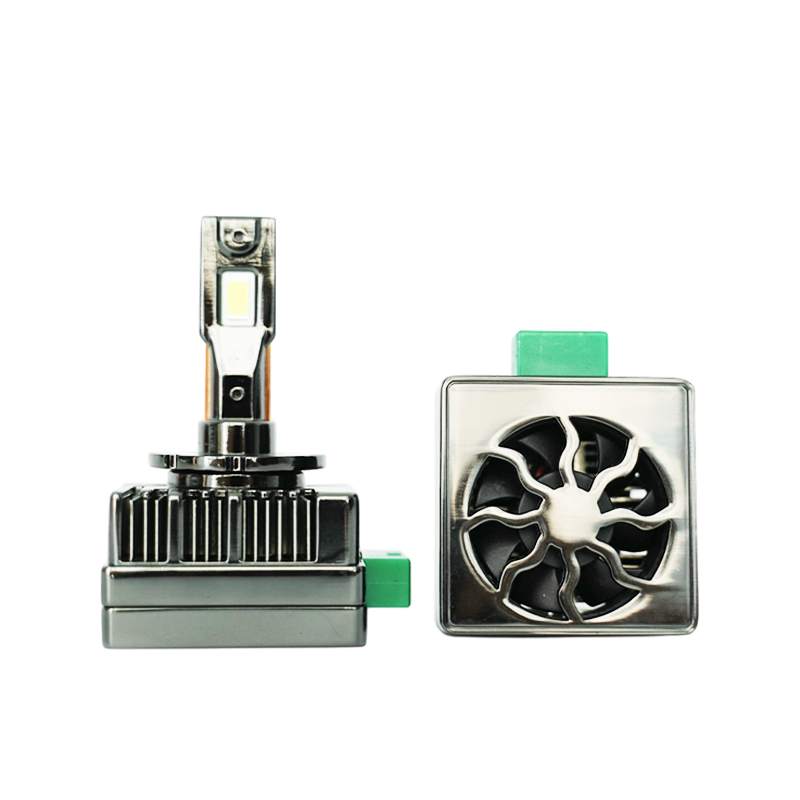
While passive heat dissipation through aluminum profiles serves as the primary cooling mechanism, some premium LED headlight designs incorporate active cooling elements. These typically consist of small axial fans drawing air through the finned profile or blower elements forcing ambient air across the heat sink surfaces.
Active cooling provides measurable benefits in extreme conditions—vehicles operating in high-ambient-temperature environments or during extended idling when vehicle cooling systems provide minimal airflow. Testing indicates that fan-assisted cooling can reduce LED junction temperatures by an additional 10-20°C compared to passive cooling alone, effectively extending component lifespan and performance stability.
However, active cooling introduces complexity, power consumption, and potential failure modes. The overwhelming majority of LED headlight applications rely exclusively on passive aluminum profile cooling, which proves entirely adequate for design ambient temperatures and duty cycles.
Comparative Analysis: Aluminum Profiles Versus Alternative Cooling Approaches
Aluminum Versus Copper Heat Sinks
While copper offers superior thermal conductivity (approximately 385 W/m·K, roughly double aluminum's performance), cost and engineering factors make copper impractical for automotive LED headlight applications. Copper's density of 8.96 g/cm³ makes equivalent heat sinks approximately 3.3 times heavier than aluminum designs. For a vehicle component subject to vibration and thermal cycling, this weight penalty translates directly to increased stresses and mounting complexity.
Copper's corrosion susceptibility in automotive environments presents additional challenges. Unlike aluminum's protective oxide layer, copper oxidizes rapidly when exposed to moisture, road salt, and temperature variations, creating green patina that insulates against heat transfer and compromises appearance. Protecting copper through nickel or other plating increases manufacturing costs significantly.
Cost differential proves decisive. Aluminum alloy 6063 costs approximately one-tenth the price of equivalent copper material. For automotive applications produced in volumes exceeding hundreds of thousands annually, this translates to tens of millions in cumulative cost difference, making copper economically unjustifiable despite minor thermal advantages.
Aluminum Profiles Versus Direct PCB Mounting
Some LED headlight designs omit dedicated heat sinks entirely, mounting LED chips directly on copper-clad printed circuit boards. This approach minimizes cost and space requirements but introduces severe thermal limitations.
Printed circuit board materials—typically glass-reinforced epoxy—conduct heat poorly, with thermal conductivity of only 0.3-0.5 W/m·K in the plane parallel to copper layers. Heat generated in the LED chip encounters immediate thermal bottleneck, with most dissipation occurring through the relatively small area where copper traces contact the PCB substrate. This fundamental limitation restricts practical power levels to approximately 10-15 watts before thermal runaway becomes inevitable.
Additionally, PCB-mounted designs concentrate heat in localized areas, creating steep temperature gradients across the headlight assembly. This thermal stress accelerates solder joint failures, reduces driver circuit reliability, and creates optical problems as non-uniform heating distorts plastic lens components.
Aluminum Profiles Versus Die-Cast Aluminum Bodies
Die-casting offers an alternative aluminum fabrication method where molten aluminum is forced into molds under high pressure. While die-cast components cost less for small production runs, several factors make extrusion profiles superior for LED thermal management.
Extrusion enables precise fin geometry optimization impossible with die-casting. Die-cast components typically feature simpler geometry due to mold complexity and part ejection requirements. Extrusion can produce fins with uniform wall thickness and optimized spacing, maximizing cooling efficiency.
Material consistency differs substantially between processes. Die-casting introduces porosity and material voids as molten aluminum cools non-uniformly, degrading actual thermal conductivity below theoretical values. Extruded profiles demonstrate superior material homogeneity and thermal performance consistency between production batches.
For high-volume automotive applications where performance consistency and thermal reliability prove critical, extrusion profiles deliver superior long-term value despite potentially higher unit costs.
Performance Validation: Testing and Certification Standards
Thermal Performance Testing Methodologies
Professional validation of aluminum profile cooling performance follows established testing protocols. Thermal imaging analysis captures temperature distributions across the heat sink surface, verifying uniform cooling and identifying hotspots that indicate design deficiencies. Infrared cameras measure surface temperatures within 0.5°C accuracy, documenting performance across operational range.
Thermal transient testing subjects aluminum profiles to rapid power-on cycles, measuring temperature response times and verifying adequate cooling response to sudden thermal loads. This testing simulates real-world vehicle operation where headlights activate instantly and encounter variable thermal loads.
Life-cycle durability testing operates LED assemblies continuously for 10,000+ hours, monitoring light output stability, color temperature consistency, and component failure rates. Quality aluminum profile designs demonstrate stable performance throughout extended operation, while inadequate cooling manifests as progressive light degradation and accelerating failure rates.
Automotive Industry Standards and Compliance
Automotive lighting components must meet stringent industry standards ensuring consistent quality and performance. Relevant testing standards include thermal cycling protocols subjecting components to -40°C to +85°C temperature extremes, salt-fog corrosion testing validating aluminum profile surface protection, and vibration testing confirming structural integrity under vehicle operation conditions.
Compliance with these standards requires aluminum profiles demonstrating:
- Thermal stability: Consistent cooling performance across full operational temperature range without material degradation
- Dimensional consistency: Extrusion tolerances within ±0.5mm ensuring proper LED chip seating and thermal interface integrity
- Material purity: Aluminum alloy composition verified to specifications ensuring thermal and mechanical properties
- Surface finish quality: Anodization or other protective coatings providing corrosion resistance without compromising thermal contact
Installation and Maintenance Considerations for Optimal Performance
Proper Installation Procedures
Even the most advanced aluminum profile design fails to deliver performance benefits if installation procedures prove inadequate. Thermal interface material application represents the most critical installation step. Excessive thermal grease creates barrier layers that impede heat transfer, while insufficient application leaves microscopic air gaps that substantially increase thermal resistance.
Professional installation guidelines recommend thermal interface material thickness of 0.1-0.3mm, achieving optimal balance between gap filling and material thickness. The LED chip substrate should be cleaned thoroughly with isopropyl alcohol before application, removing contaminants that degrade thermal contact.
Mounting pressure requires careful attention. Adequate clamping force ensures good thermal contact without deforming aluminum profiles or damaging LED components. Recommended clamping pressure typically ranges from 0.5-2.0 MPa depending on component geometry, verified through manufacturing documentation.
Maintenance and Long-Term Performance
Aluminum profiles maintain thermal performance throughout their operational life with minimal maintenance in typical automotive environments. However, several factors can degrade cooling efficiency over extended operation:
- Dust accumulation: Road dust and debris can accumulate on fin surfaces, reducing effective surface area and restricting airflow. Periodic cleaning with compressed air maintains optimal cooling
- Corrosion protection: While aluminum's natural oxide provides corrosion resistance, aggressive road salt environments may require protective anodized coatings. Quality manufacturing ensures these coatings remain intact
- Thermal interface degradation: Some thermal greases degrade over decades of thermal cycling, potentially increasing interface resistance. Most automotive applications exceed component lifespan before this becomes problematic
- Headlight assembly inspection: Regular vehicle maintenance should include visual inspection of headlight transparency, as clouding indicates elevated temperatures that may compromise LED lifespan
Unlike incandescent or halogen headlights requiring periodic replacement, LED headlight systems with proper aluminum profile cooling demonstrate exceptional longevity, commonly exceeding 10-year vehicle lifespan without performance degradation or replacement requirements.
Industry Applications and Real-World Implementation Examples
Automotive Headlight Integration
Modern vehicle headlight assemblies integrate aluminum profile heat sinks as essential structural and thermal components. LED arrays mount directly onto profile surfaces, with profiles serving dual purposes: thermal management and mechanical support structure. This integration approach reduces component count and manufacturing complexity compared to separate thermal and structural elements.
Vehicle manufacturers employ aluminum profiles in both primary headlight configurations and supplementary lighting systems including fog lights, daytime running lights, and ambient lighting. The versatility of extrusion profiles enables cost-effective customization for different vehicle platforms, each requiring distinct thermal and spatial solutions.
Commercial Lighting and Industrial Applications
Beyond automotive applications, 6063 aluminum profiles serve as standard thermal solutions for commercial LED lighting including high-power spotlights, industrial work lights, and commercial signage. These applications often push thermal boundaries more aggressively than automotive, with higher power densities and less controlled operating environments. Aluminum profiles prove essential for maintaining reliable performance in these demanding contexts.
The scalability of aluminum profile manufacturing enables economical production for diverse lighting specifications, from compact assemblies generating 10 watts to substantial installations exceeding 200 watts.
Future Developments and Emerging Thermal Management Innovations
Advanced Aluminum Alloy Variants
While 6063 dominates current applications, research continues exploring aluminum alloy variations optimizing specific characteristics. Some investigations target enhanced thermal conductivity through modified alloying elements, seeking improvements over 6063's 201 W/m·K baseline. Others focus on superior corrosion resistance for extreme marine environments or improved mechanical properties for high-vibration applications.
Additive manufacturing technologies including selective laser melting enable creation of complex three-dimensional aluminum geometries impossible through conventional extrusion, potentially enabling unprecedented fin designs. However, these technologies currently lack the cost efficiency and production scalability required for automotive mass manufacturing.
Hybrid Material Approaches
Emerging designs combine aluminum profiles with supplementary materials targeting specific performance objectives. Incorporating phase-change materials within aluminum structures temporarily absorbs excess heat during transient thermal spikes, stabilizing junction temperatures. Graphene-enhanced thermal interface materials promise superior conductivity while maintaining application ease.
These hybrid approaches remain largely experimental, with cost and manufacturing complexity currently restricting adoption. However, as supporting technologies mature and costs decline, hybrid solutions may complement traditional aluminum cooling in premium applications requiring exceptional thermal performance.
Integrated Electronics and Smart Thermal Management
Future LED headlight systems will likely incorporate temperature monitoring and adaptive management electronics. Embedded sensors measuring aluminum profile surface temperature enable active control algorithms adjusting LED current levels to maintain target operating temperatures, optimizing performance while preventing excessive thermal stress. These systems represent the next evolution beyond passive aluminum cooling, leveraging superior thermal management to enable higher-power LED arrays.
Conclusion: The Indispensable Role of 6063 Aluminum Profiles in LED Headlight Excellence
The 6063 aluminum profile has established itself as the definitive thermal solution for LED headlight bulbs through a convergence of exceptional material properties, innovative engineering design, proven real-world performance, and cost-effective manufacturing. The material's superior thermal conductivity, combined with extrusion's capacity to create optimized fin geometries, enables heat dissipation at scales transforming LED operation from thermally limited to thermally unlimited.
The relationship between thermal management and LED performance proves both direct and measurable. Heat dissipation differences of just 10-20°C determine whether LED bulbs maintain stable brightness and color throughout their operational life or experience progressive degradation. In this critical function, aluminum profiles deliver performance that alternative cooling approaches cannot match economically.
As LED headlight bulbs continue advancing toward higher power outputs and improved optical performance, the fundamental importance of aluminum profile thermal management only intensifies. Professional lighting engineers, automotive manufacturers, and quality-conscious consumers recognize that superior cooling directly translates to superior reliability, longevity, and performance consistency—the hallmarks of premium LED headlight technology.
For anyone seeking to understand the engineering behind reliable LED headlight systems, the answer begins and ends with proper thermal management through optimized aluminum profile design—a solution proven by millions of operating vehicles and endorsed by leading automotive manufacturers worldwide.
Frequently Asked Questions
Q1: What is the thermal conductivity of 6063 aluminum, and why does it matter?
6063 aluminum conducts heat at approximately 201 W/m·K, making it roughly 400 times more thermally conductive than traditional circuit board materials. This exceptional conductivity enables rapid heat transfer from LED junctions to surrounding air, maintaining lower operating temperatures that preserve light output, color stability, and component lifespan. Higher thermal conductivity directly translates to lower operating temperatures and superior long-term reliability.
Q2: How much does an aluminum profile heat sink reduce LED operating temperature compared to passive cooling?
Effective aluminum profile cooling reduces total thermal resistance from approximately 8-10 K/W in passive mounting to 1.5-2.5 K/W with optimized fins. For a typical 30-watt LED headlight, this translates to temperature reduction from 240-300°C to just 45-75°C above ambient conditions. This dramatic difference determines whether components operate safely or experience thermal failure within seconds.
Q3: Why is aluminum preferred over copper for automotive LED heat sinks?
While copper offers superior thermal conductivity, aluminum offers decisive advantages in automotive applications. Aluminum weighs one-third as much as copper, reducing vehicle weight and vibration stress. Aluminum resists corrosion through natural oxide formation, while copper requires expensive protective plating. Most critically, aluminum costs approximately one-tenth the price of equivalent copper components. For high-volume automotive production, aluminum's cost advantage typically outweighs minor thermal superiority of copper.
Q4: Can aluminum profiles be directly mounted without thermal interface materials?
Direct mounting without thermal interface materials introduces microscopic air gaps between LED substrate and aluminum profile surfaces. These gaps create substantial thermal resistance, typically reducing cooling efficiency by 30-50%. Professional designs always employ thermal greases, pads, or adhesives that fill surface irregularities and maximize heat transfer across the critical junction-to-sink interface.
Q5: How does dust accumulation affect aluminum profile cooling performance?
Dust and debris accumulating on fin surfaces reduces effective surface area and restricts air circulation. For headlights operating in dusty environments, cooling performance can degrade by 15-25% if maintenance is neglected. Periodic cleaning with compressed air maintains optimal performance. Most automotive applications in typical driving environments encounter minimal dust accumulation, with maintenance requirements limited to occasional inspection.
Q6: Do aluminum profile heat sinks require active cooling fans?
The overwhelming majority of automotive LED headlights rely exclusively on passive aluminum profile cooling, eliminating complexity and power consumption requirements of active fan systems. Passive cooling proves entirely adequate for normal driving conditions. Active cooling becomes beneficial only in extreme scenarios—vehicles operating continuously in very high ambient temperatures or during extended idling with minimal vehicle airflow. Most applications don't justify the added complexity.
Q7: What fin spacing is optimal for aluminum profile heat sinks?
Optimal fin spacing typically ranges from 3-8mm, balancing surface area gain against airflow restriction. Fins positioned too closely together create laminar airflow channels where air becomes thermally saturated, reducing cooling effectiveness. Widely-spaced fins waste material and manufacturing capacity. Engineers select specific spacing based on anticipated airflow characteristics and thermal load requirements for each application.
Q8: How long do aluminum profile heat sinks last in automotive applications?
Quality 6063 aluminum profiles demonstrate exceptional longevity in automotive environments. The natural oxide layer provides corrosion resistance that protects against moisture and road salt. With proper anodization or protective coating, aluminum profiles typically outlast vehicle lifespan—often exceeding 10-15 years without degradation. LED bulbs with proper aluminum cooling frequently outlast the vehicles in which they're installed.
Q9: Can aluminum profiles be recycled after product end-of-life?
Aluminum proves highly recyclable, maintaining material properties through multiple recycling cycles. Recycling aluminum requires only 5% of the energy demanded for primary aluminum production, making it environmentally advantageous. End-of-life LED headlight assemblies containing aluminum profiles represent valuable material recovery sources, supporting circular economy principles in automotive manufacturing.
Q10: What distinguishes premium aluminum profiles from budget alternatives?
Premium aluminum profiles feature precise dimensional tolerances (±0.5mm or better) ensuring consistent LED chip seating and thermal contact. Quality materials exhibit consistent thermal conductivity across production batches. Surface finish quality—including anodization thickness and uniformity—protects against corrosion while maintaining thermal performance. Premium profiles undergo rigorous thermal testing and quality verification. While premium components cost more initially, superior thermal performance and extended lifespan deliver better long-term value for demanding automotive applications.